The Future Tech Role Is the Product Architect
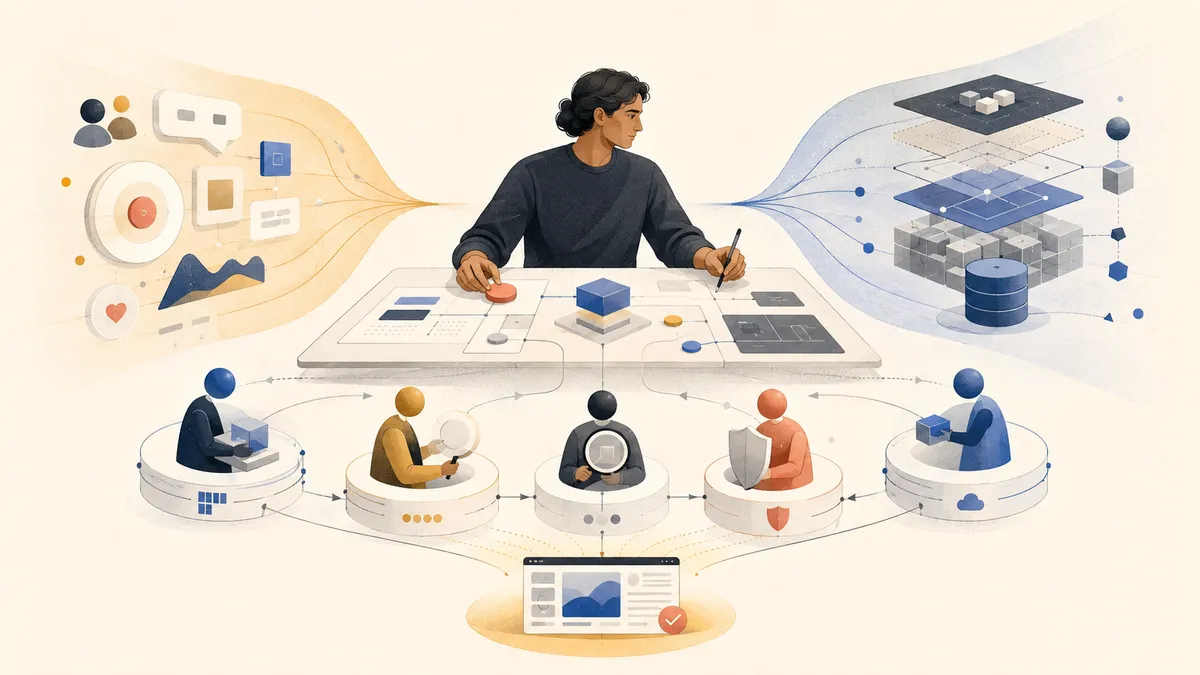
TL;DR: Coding is moving from humans to agents. As agents get better at implementing, testing, and reviewing software, the human role moves toward deciding what should be built, defining how the system should work, and verifying the result. The person who owns all three is the product architect.
Software teams are built around the assumption that writing production code is expensive.
A product manager decides what should be built. A software architect decides how the system should work. Engineers then spend weeks or months implementing it.
This separation made sense when implementation was the slowest part of building software.
It isn't anymore.
Agents are already writing real production code. OpenAI built an internal product without humans manually writing a single line of code. In five months, a small team using Codex produced roughly a million lines of code and merged around 1,500 pull requests. The agents wrote the product, tests, infrastructure, and internal tools. The humans defined what needed to be done and checked the result. OpenAI describes this as: humans steer, agents execute. Cursor is already talking about fleets of agents that plan, build, test, monitor, and maintain software.
This is not just a faster way to write code.
It changes how software teams should be organised.
You are now the bottleneck
If an agent can build a feature in a few hours, but it takes three days to decide exactly what the feature should do, implementation is no longer the bottleneck.
You are.
The product manager writes a requirement. The architect turns it into a system design. The engineer finds the gaps. Questions go back through the chain. Meetings happen. Documents get updated. Meanwhile, the agent could have built and tested several versions.
Giving every engineer a coding agent does not solve this. You get faster code production while keeping the same slow decision process around it.
Someone still needs to decide:
- What problem are we solving?
- What should the product actually do?
- How should the system work?
- Which trade-offs are acceptable?
- How do we know the result is correct?
If those decisions remain split across multiple people and handoffs, the company will still move at human coordination speed.
When implementation becomes this fast, product and architecture can no longer remain completely separate. The person deciding what should exist also needs to understand the system in which it will run.
That person is the product architect.
The product architect
A product manager decides what problem should be solved.
A software architect decides how the system should be structured.
A tech lead coordinates how engineers implement it.
The product architect owns the whole loop.
They understand the problem, decide on the solution, design the system, set the constraints, direct the agents, and verify what gets built.
On the product side, they define the outcome, requirements, priorities, use cases, failure conditions, and acceptance criteria.
This does not mean writing a huge product document for every change. A simple task may only need a clear instruction. A complex feature needs a proper specification. The level of detail should match the complexity of the task.
On the architecture side, they decide the database, infrastructure, data model, APIs, system boundaries, security model, scaling strategy, and other choices that affect how the product works or what it can become later.
Architecture sets the constraints within which agents work.
The human decides the system-level choices. The agents decide how to implement them in code.
An agent can choose the functions, classes, libraries, algorithms, and internal patterns it needs. But data ownership, security boundaries, and scaling strategy shape the product. Those decisions belong to the product architect.
The specification also becomes more important because it is no longer just a document passed to another person. It becomes an input the agents directly work from. Other agents can then use the same specification to test and review what was built.
The same applies to design. A designer sets the colours, typography, components, interaction patterns, and platform rules, then reviews the product from time to time. Agents can build individual interfaces without inventing a new design system for every feature.
The agent team becomes the product architect's toolkit.
Engineers have always shaped personal workflows around editors such as VS Code or PyCharm, along with terminals, plugins, and scripts. Product architects will do the same with agents.
One agent may implement a feature. Another may test it. Another may check security and architecture. Another may deploy it and verify the workflow.
There is no fixed agent team that works for every product. The roles depend on what is being built. But each agent should have a clear responsibility, and the agents should be able to work together without asking the human to manage every small handoff.
Grok Bot is an early example of this. You can create persistent bots, give each one a job, run them in parallel, and let them pass work between themselves. They keep context and return when they need approval.
Now apply the same model to software development.
You could have specialised agents for implementation, testing, review, security, and deployment. They escalate only when a decision changes the product, architecture, or acceptable trade-offs.
Working with agents will become a core part of the job. Each product architect will decide which agents exist, what they own, which tools they can use, what context they retain, and when they should return to the human. That working relationship will improve as the agents learn the product and its architecture.
This is still a hands-on role.
The product architect is not someone who draws a few diagrams and disappears. They work with the agents every day: clarifying requirements, testing features, correcting specifications, making trade-offs, and updating constraints.
They may stop typing most of the code. They do not stop building.
The way humans review work changes too.
Today, agents write a lot of code and humans review it. As models improve, agents will also run the tests, review the code, find bugs, and fix one another's work.
This does not mean code stops being reviewed. It means humans stop being responsible for code-quality review.
Humans review the functionality.
They use the feature, test the complete workflow, verify the important use cases, and check whether it solves the intended problem.
The pull request becomes less about a diff and more about a working product increment. It should show what was built, how it was tested, and where the human can try it.
Well-tested production code is not code with a lot of unit tests. It is code that works functionally, handles the expected use cases, and satisfies the product and system constraints.
That is what the human verifies.
Fast implementation also changes how much time we should spend debating reversible decisions.
If an agent can build a version today, test it, scrap it, and build another one tomorrow, we should do that. We do not need to discuss for three weeks what can be tested in a day.
But not every decision is reversible. Data ownership, security, compliance, infrastructure foundations, and long-term platform choices still need careful thought.
The product architect needs to know the difference.
Build teams around judgment
The product architect is not half a product manager and half a software architect.
The role needs enough product depth to define the right outcome and enough technical depth to design the system that can deliver it. The point is not to combine two roles and do both badly. The point is to remove the gap between them.
This is the natural next step for senior engineers, tech leads, technical founders, and engineering leaders working with agents. Their value will come less from how much code they can personally produce and more from how well they can turn an ambiguous problem into something agents can build and verify.
Founders and engineering leaders should start changing how they build teams:
- Stop measuring engineering mainly through code output.
- Find engineers who have both product judgment and architectural depth.
- Give them ownership from problem to production outcome.
- Build agent workflows with separate implementation, testing, review, and validation responsibilities.
- Invest in product specifications, architecture constraints, design-language documents, and functional testing.
- Review working products, not only code diffs.
Companies that simply give every developer a coding agent will produce more code.
They will miss the bigger change.
Code is becoming abundant. Good judgment is not.
The future will not belong to the person who can produce the most code. Agents will win that contest.
It will belong to the person who can decide what deserves to be built, design the system that should contain it, and lead agents from intent to a verified outcome.
That person is the product architect.